Every kopitiam has a rhythm, and staffing to the wrong one wastes money at both ends: too few hands at the rush means slow service and walkouts, too many in the quiet hours means paying people to wait. Eleven months of this shop's timestamped orders show the rhythm clearly, and it is sharper than most owners assume.
Two patterns run the week. Business tilts hard to the weekend, and inside any day it tilts hard to one late-morning hour. Get those two right and the rest of the schedule almost sets itself.
The numbers
Sunday
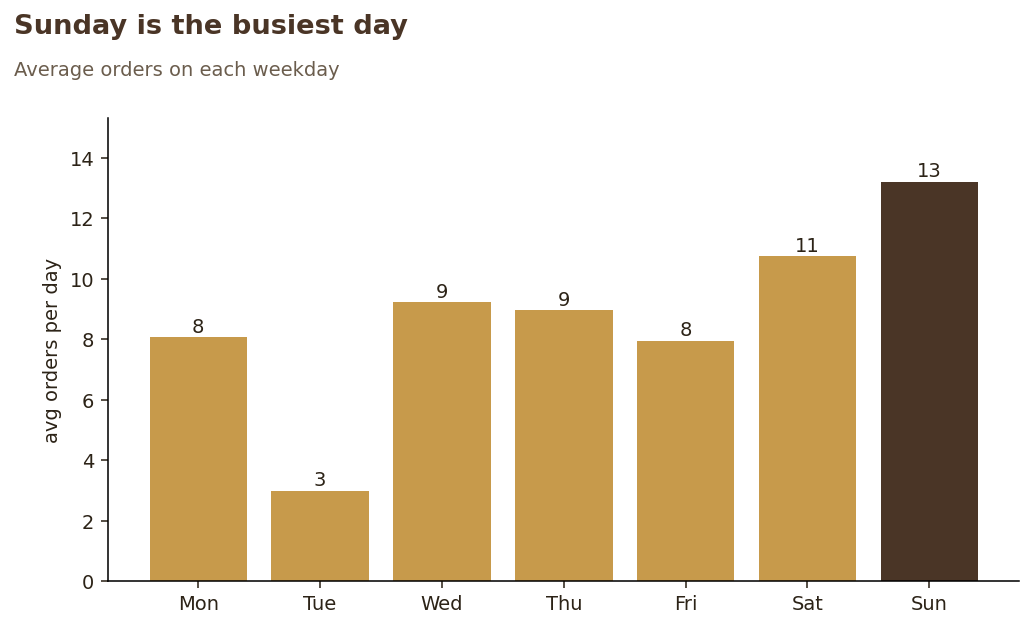
the busiest day, ~13 orders
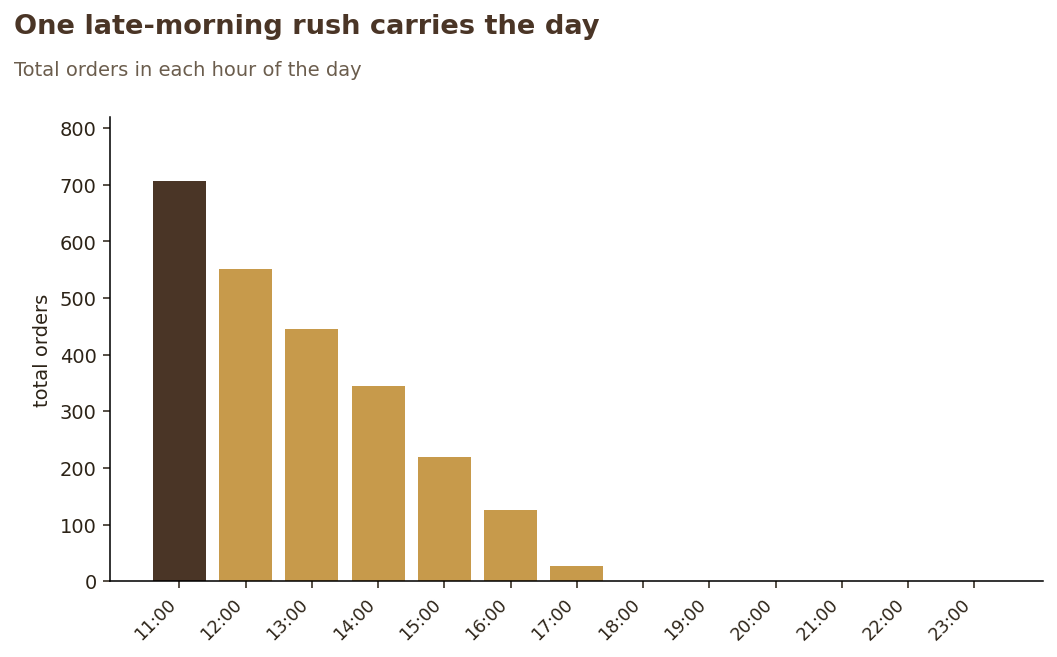
11am
the single peak hour
+41%
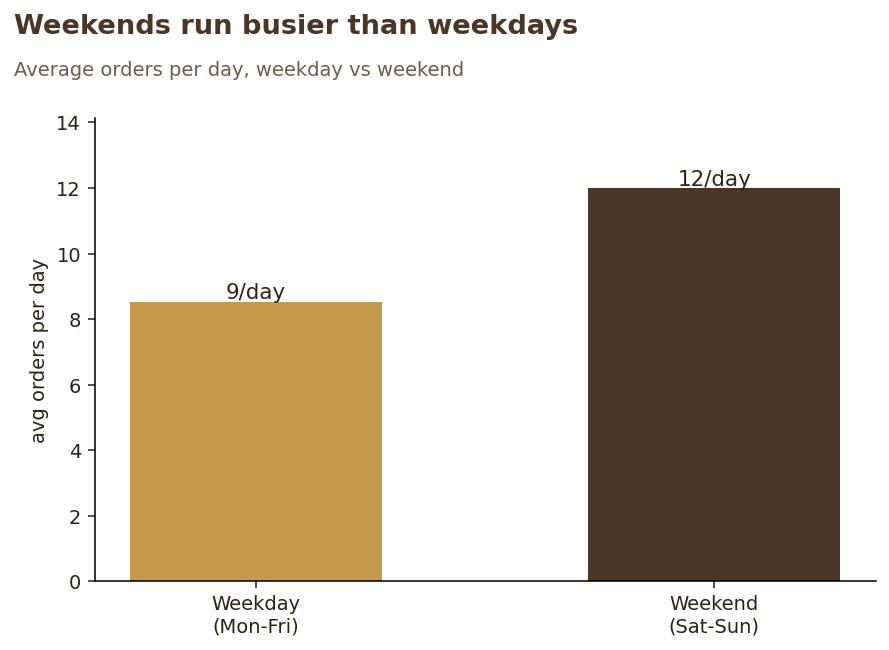
weekends busier than weekdays
Tue
effectively a rest day
“The shop earns its week on the weekend, and its day in one late-morning hour.”
What the data shows
1. Sunday is the busiest day
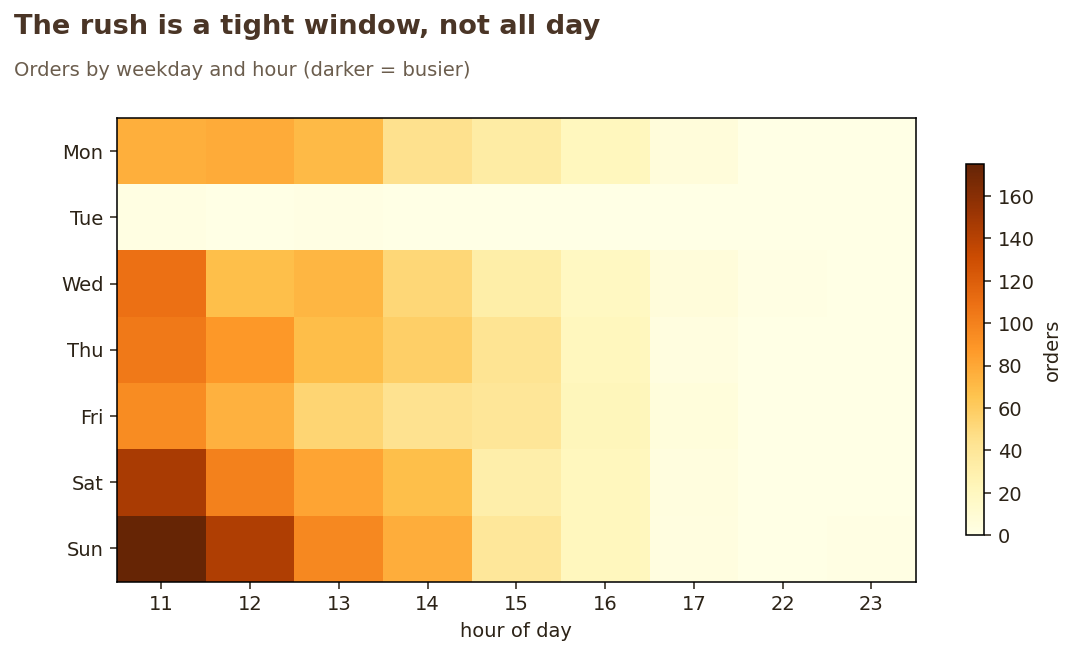
Sunday averages about 13 orders a day and Saturday about 11, against 8 to 9 on a typical weekday. The two weekend days stand clearly above the rest of the week.
Sunday is the day to be fully staffed and fully stocked. It is not a normal day with a few more customers, it is the peak the week is built on.
2. Weekends carry the week
Put Saturday and Sunday together and the weekend runs 41% busier per day than the weekday, 12.0 orders a day against 8.5. The shop earns a disproportionate share of its week in two days.
Roster and prep should lean to the weekend, not spread evenly across seven days. Extra hands and extra stock on Saturday and Sunday pay back harder than the same effort midweek.
3. One late-morning rush carries the day
Within the day the traffic is not spread out, it spikes. The 11am hour alone holds 706 orders across the period, close to a third of everything sold, sitting right at the start of the recorded trading hours of 11am to 11pm. Demand peaks hard in late morning, then eases through the afternoon and evening.
This is the hour the whole operation should be built around. Food prep and the full crew need to be ready before 11, not building up during it. A kitchen still warming up at 11am is missing the busiest sixty minutes of the day.
4. The rush is a tight window, and Tuesday is closed
The heatmap shows the peak is concentrated, heaviest in the late-morning band on the weekend, with the rest of the grid much lighter. You do not need a full crew from open to close, you need a full crew for the rush and a lean one around it. One row stands out for the opposite reason: Tuesday shows only 3 orders in 11 months, so the shop effectively rests on Tuesdays.
Two savings follow. Staff to the rush, not the clock, and run lean through the afternoon lull. And read the week as six days, not seven, so averages and rosters are not diluted by a closed Tuesday.
Method & data
The data is 11 months of the kopitiam's own timestamped orders (July 2019 to June 2020), 2,421 orders with a valid date and time. Busyness is measured by order count, how many orders arrive, which is the honest read of footfall and kitchen load.
Two notes on limits. The recorded trading hours run 11am to 11pm, so the peak sits at the start of the captured window; if the shop in fact opens earlier, an earlier build-up would not appear here. And order count, not ringgit, is the busyness measure, because the order-total column was unreliable and no per-item prices exist.
Conclusion
This shop's demand is concentrated in two ways, and both point the same direction. The week is won on Saturday and Sunday, and the day is won in the 11am hour. Everything else, the weekday afternoons and evenings, is quieter and cheaper to cover.
The moves are simple: staff and stock heaviest for the weekend and the late-morning rush, run lean through the afternoon lull, and plan the week as six days because Tuesday is closed. None of this needs more budget, only pointing the hands and the prep at the hours that actually carry the shop.